|
ACIG Exclusives
Chapter 16 : 201 AA Squadron |
 |
|
|
|
| No.201UH Army Aviation squadron was raised at Bangalore and became the first to receive the HAL Dhruv Advanced Light Helicopter (ALH), on 15 Sept. 2001. This was a quantum jump for the Army, which had previously operated only Cheetah and Chetak helicopters. Since then, the squadron has been actively involved in Aero India, giving a short demonstration of operations that would involve Army Aviation supporting commandos on an assault role. The demonstration would include a mock area sweep by a HAL Lancer, followed by an airdrop of a jeep, equipment and para-commandos from the Dhruv. Despite this sequence being a rather interesting display, it was and always has been carried out at quite a distance away from the public gathering for some strange reason. Although No.201 is located inside HAL's Helicopter Division campus at Bangalore, they deploy to the frontline regularly. | |
|
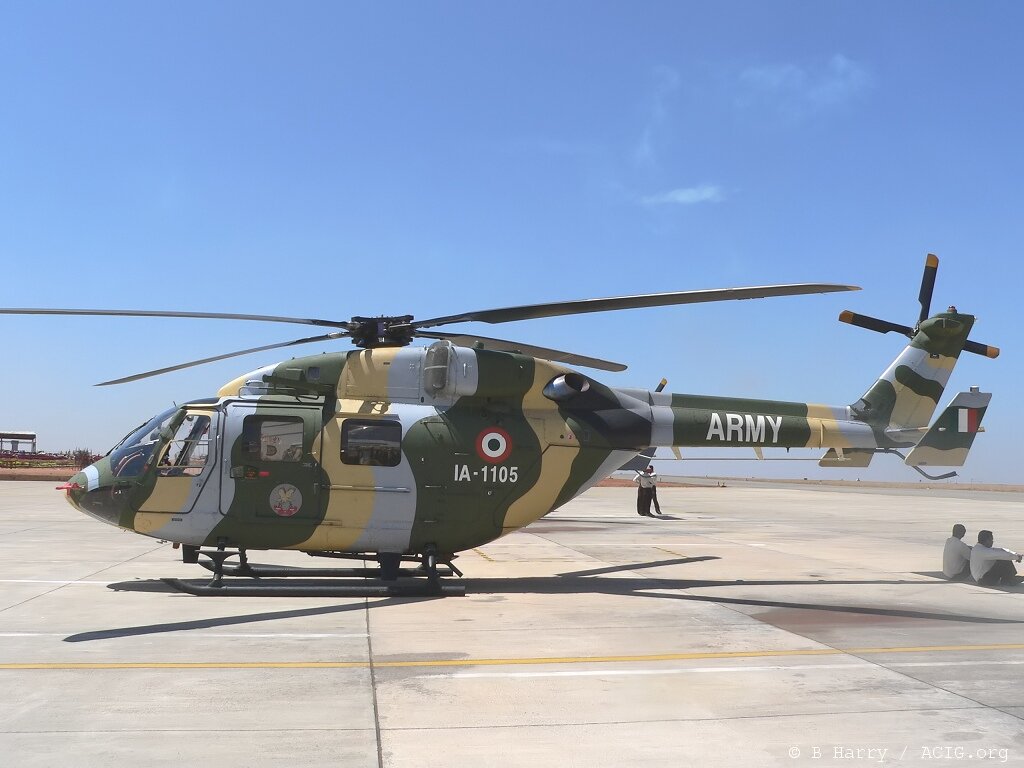
IA-1105 was the skid-version of the Dhruv, on static display. Note the logo of Army aviation. The final WSI version of the Army-variant of the Dhruv is to have a 8-12 µm nav-FLIR with a 288x4 MCT LFPA detector, CCD and a separate target acquisition system consisting of a Thermal sight with a detection range of 8 km and a laser rangefinder of range 6.0 km and accuracy ± 5 m. This will in turn, be integrated with the Nag ATGM system. The optics have been developed by IRDE labs of the DRDO. |
| FILE : 220 KB | |

|
IA-1103, starts off the demonstration by bringing in a jeep for the para-commandos to use. IA-1103 was one of the two Dhruvs formally handed over to Army Aviation on March 20, 2002. No.201 remains the Army's solitary Dhruv squadron, operating these helicopters in the utility role. The Dhruv is capable of underslung load up to 1500 kg. |
| FILE : 188 KB | |

|
A closer look at IA-1103 before it detaches the Jeep. |
| FILE : 192 KB | |

|
The function of the HAL Lancer, an upgraded and armed derivative (not variant) of the Cheetah helicopter, in this case, is to sanitize the area of any opposition before the para-commandos are actually dropped. Lancer's are operated with the Indian Army's No.4 (I) AA Flight. This example (Z-1857), carries two attack pods, each containing a 12.7 mm gun and three 70 mm rockets. Both the Lancer and Dhruv have been exported to Nepal. |
| FILE : 214 KB | |

|
Once the area is secure, the commandos may be injected. A second Dhruv, IA-1102, arrives at the scene, carrying the load of para-commandos for the air drop. |
| FILE : 194 KB | |

|
IA-1102 gets ready to deploy it's occupants from the slithering rope. |
| FILE : 207 KB | |

|
The first para-commando prepares to slither down. Slithering trials were also carried out by Chilean troops when a team visited that country in June 2004. |
| FILE : 222 KB | |

|
Followed by another. |
| FILE : 145 KB | |

|
And another. The air dropped commandos will now proceed to the jeep and drive away. |
| FILE : 211 KB | |

|
Mission accomplished, IA-1102 leaves the area. |
| FILE : 219 KB | |

|
IA-1103 returns to deploy it's own load of commandos, as well. |
| FILE : 195 KB | |

|
Ropes are deployed from the cargo bay as well as the main door. The clamshell cabin door is opened and a second rope is deployed from the same location. |
| FILE : 233 KB | |

|
Two commandos slither down from the helicopter and halt midway. |
| FILE : 191 KB | |

|
A total of four commandos are deployed, but do not slither down all the way to the ground like the previous batch. After being hauled around for a while, the commandos are finally lowered to the ground. |
| FILE : 180 KB | |

|
IA-1105 takes off and leaves the venue, early in the morning. Following their performance at the end of each day, all the Army Dhruvs flew back to HAL's Helicopter Division at Bangalore. |
| FILE : 202 KB | |
|
|
|
|
|
|