|
ACIG Exclusives
Chapter 4 : White Tigers |
 |
|
|
|
| Sea Harriers of the Indian Navy had previously taken part in one of the earlier, minor air shows held at Yelahanka in the mid-90s. Despite their low profile and occasional appearances, they are one of the better known aircraft types in India, mostly thanks to their display of VTOL capabilities. Their return appearance at Aero India 2005, not confirmed till the very last minute, was thus a much appreciated action, forming a star attraction once again. The aircraft were also relevant to the event by virtue of the announcement of their upgradation plans that ended years of speculation about the same. | |

|
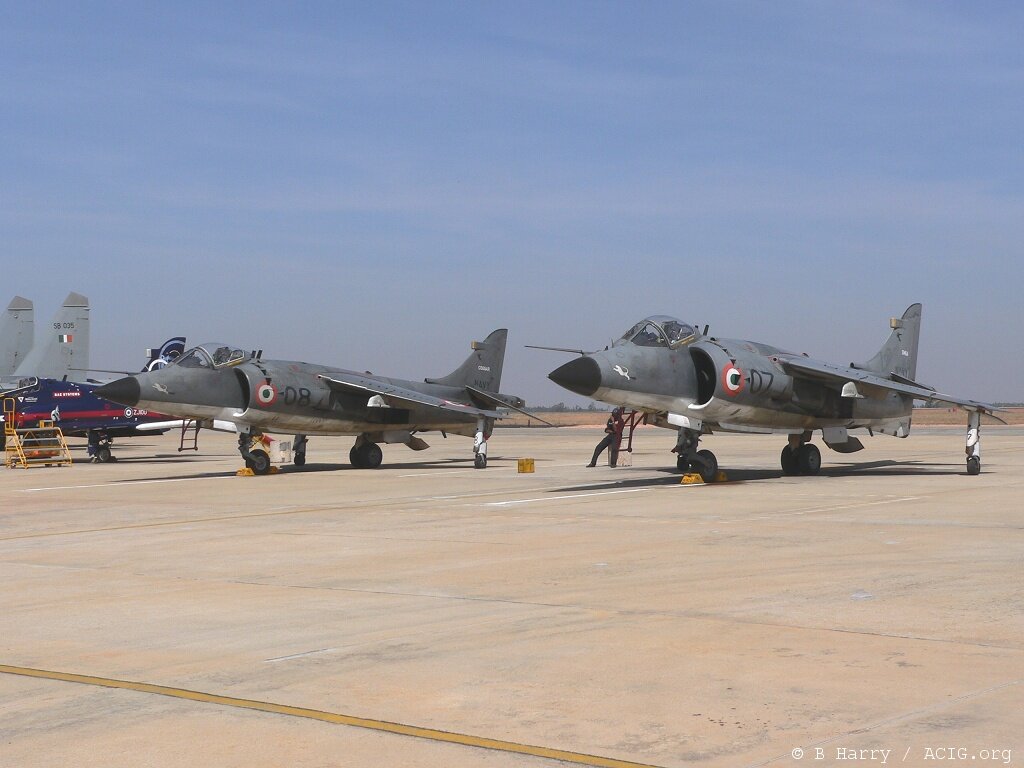
Two Sea Harriers (Foregorund - IN-607 "Simba" and Background - IN-608 "Cougar") from the INAS 551B "Braves" squadron (temporary transfers from INAS 300 "White Tigers") took part in Aero India. Both FRS.51 fighter and T.60 trainer variants of the Sea Harrier are also operated by a second squadron, INAS 551-B "The Braves", formerly the Sea Harrier Operational Flying Training Unit (SHOFTU), which undertakes regular sorties besides training and has also taken part in joint exercises such as Exercise "Varuna", with the French Navy. |
| FILE : 177 KB | |
|
Having arrived straight from intensive operational deployment off Goa (Dabolim), these two units look absolutely flogged and covered with black smut but structurally, in excellent shape. Their mothership, the carrier Viraat, only recently left Mumbai to join active service following a prolonged refit at Cochin and Mumbai. |
| FILE : 215 KB | |

|
Trials of the new generation "Tarang" RWR, known as the "Roshini" on the Sea Harrier, began some time back and fleet-wide fitment is to commence after some modifications. The Roshini differs from the Tarang HADF.Mk.II only in terms of software and a new antennae design that was required due to increased installation area. The contract to fit the Tarang system aboard the MiG-29K on order for the Indian Navy, has already been signed. |
| FILE : 180 KB | |

|
The Blue Fox radar is considered one of the aircraft's weak points, being susceptible to sea-clutter in the downlook mode which meant that efficient interceptions needed to be carried out with the Sea Harrier flying below it's designated target. After the delivery of the first batch in 1983, a replacement radar was immediately sought but the Blue Vixen was still in development at the time, resulting in the weakness being overcome only through intensive training. The interception also heavily banks on the fighter controller who coordinates the intercept while the Blue Fox is switched off for the first stage of an interception. |
| FILE : 191 KB | |

|
Batch-2 Sea Harriers were delivered in 1992 with Sea Eagle AsHM compatibility, the Magic-2 all-aspect AAM, improved software for the weapons aiming computer, increased RWR coverage and photo-recce pods but with the same Blue Fox radar. All Sea Harriers were eventually upgraded to this standard. ECM pods manufactured by HAL, twin rails for the Magic-2, a CMDS and further RWR improvements were also introduced around the same time. |
| FILE : 205 KB | |

|
"Cougar" taxies out in preparation for take-off. Most of the assigned Harrier flight displays were performed by this unit alone while "Simba" provided backup and also flew occasionally. IN-608 was one of the aircraft that "fought" the Rafale-M during the joint exercise, 'Varuna 2004/1' |
| FILE : 224 KB | |

|
The aircraft turns towards the main runway from the taxiway, as a NAL Hansa light aircraft, takes off in the background. The need for a modern radar and BVRAAMs for the type was identified in the 80s but upgradation to this standard will only be done in the near future. The FRS.Mk.2 type now retired by the Royal Navy, will not be acquired by the Indian Navy. |
| FILE : 195 KB | |

|
The upgrade is most likely to involve the Elta EL/M-2032 radar and Rafael Derby BVRAAMs, the contract very close to being signed. HAL will undertake the integration and the upgrade on the lines of it's MiG-27ML and Jaguar-IM and Jaguar DARIN-II upgrades which also involve new mission computers among other avionics. |
| FILE : 208 KB | |

|
Cougar prepares for take-off as the crowd waits with bated breath. In contrast to the "dirty" look of these two FRS.51s, the T.60 trainers are always seen in spic and span condition, as are the Kirans of INAS 551-A. The Navy, notably, performs better paintjobs than the IAF. |
| FILE : 212 KB | |

|
According to press reports, the upgrade will start with the purchase of an initial batch of 20 Derby BVRAAMs, including 6 training rounds, worth $25 million, the selection confirmed with the contract ready. The icon of the Matra Magic AAM painted below the cockpit, signifies a live firing and was not spotted earlier on the same aircraft, meaning that the live firing was recent. |
| FILE : 196 KB | |

|
Since the runway was not suitable for a vertical, Cougar performs a short, rolling take-off instead. The vertical take-off also involves a lot of fuel consumption, this being one of the main reasons that necessitated ski-jumps on the carriers that operated them. The aircraft banks and performs a few wide turns at high speed, before slowing down for a hover. |
| FILE : 177 KB | |

|
The aircraft performs what everyone was waiting for - a static vertical hover for a rather long duration albeit at a good distance from the crowd itself. The whole display routine itself, was however short in comparison to aerobatic routines by other aircraft. |
| FILE : 175 KB | |

|
Rather than vectoring its nozzles back and flying forward from the hover state, the aircraft concludes the latter and it's display routine through a vertical landing. This won't burn the runway or tarmac, as a vertical take-off at high thrust, would. |
| FILE : 180 KB | |

|
Cougar taxies forth and prepares for flight on another day, this time, being piloted by someone else. IN-608 and IN-607 are from the second Sea Harrier batch, delivered in 1989-90. Despite their weaknesses in certain areas, the Sea Harriers of the Navy have performed very well against the IAF, in DACT. |
| FILE : 201 KB | |

|
Cougar once again, concludes through a vertical landing. When INAS 300 first recommissioned with the Sea Harrier, the unit was under the command of Cdr. Arun Prakash, now the Admiral of the fleet, who has also since, flown the Hawk, the Su-27KUB and the Rafale-M among other types. |
| FILE : 194 KB | |
|
|
|
|
|
|