|
ACIG Exclusives
Chapter 15 : Fulcrum shift |
 |
|
|
|
| Long before the IAF had launched it's actual tender of 126 new medium-weight combat aircraft, RAC MiG's newer variants of the MiG-29 Fulcrum, had always been showcased at Aero India. This included the MiG-29K in 2001 and the MiG-29M2 MRCA in 2003. The M2 returned in 2005, with an upgraded aerial display that lead many to percept that this was the most impressive aircraft at the show. | |

|
This is the MiG-29M2 MRCA's second visit to Aero India. ASTE test pilot P P Reddy, seen on the right, will get to fly the aircraft on a familiarization sortie for the first time. |
| FILE : 220 KB | |

|
The MiG-29M2 and the Mirage-2000-5 Mk.II are the primary candidates for the IAF's MRCA requirements although it is widely believed that the Mirage-2000 will be chosen in the end. Either way, the Indian Navy will receive similar if not better capabilities with the induction of the MiG-29K and MiG-29KUB for operation from INS 'Vikramaditya' (ex-Gorshkov). Note the Kh-35 AsHM, which will be one of the MiG-29K's primary weapons. |
| FILE : 218 KB | |

|
The MiG-29M2 was here but the most likely choice for the IAF MRCA requirement, the Mirage-2000-5 Mk.II , never once, came to Aero India. Perhaps Dassault takes the deal for granted, noting the image of the Mirage within the IAF. |
| FILE : 211 KB | |

|
As the MiG-29M2 taxies out, one wonders if it's future critically depends on the Indian MRCA contract? The flight performance of the MiG has been refined with higher thrust engines and aerodynamic improvements including a sharper LERX and FBW control whereas the Mirage upgrade concentrates on avionics and increased internal fuel for general improvement in the attack role, making for a slightly heavier variant. |
| FILE : 228 KB | |

|
Last minute checks before continuing to taxi to the take off point. How this aircraft compares to it's delta winged contender overall, can and will only be revealed after more than a year of extensive evaluation. Both of the aircraft are highly contrasting examples. The MiG-29M2 is piloted by Pavel N.Vlasov, with Mikhail Belyaev in the rear seat. |
| FILE : 222 KB | |

|
In air-to-air DACT, the Mirage-2000H is no match for the MiG-29A/B but the in consideration of multi-role capabilities, the trend is reversed. Ironically, HAL was close to the license production of either the MiG-29A or the Mirage-2000H/TH in the late 80s. Around two decades later, it will be producing a derivative of either one. |
| FILE : 200 KB | |

|
The M2 awaits it's turn. The installation of the second seat reduces internal fuel which in turn, lowers the overall range significantly, compared to the single seat MiG-29M. In contrast, the two seat variant of the Mirage-2000-5 Mk.II has a mere 2% reduction in internal fuel. |
| FILE : 199 KB | |

|
The M2 makes a very short take off and banks right. Like the MiG-29K, the M2 is offered with the Phazotron Zhuk-ME radar while the NIIP Bars-29 is still under development. The new engines are notably, less smoky than the conventional RD-33 but not by a great margin. |
| FILE : 222 KB | |

|
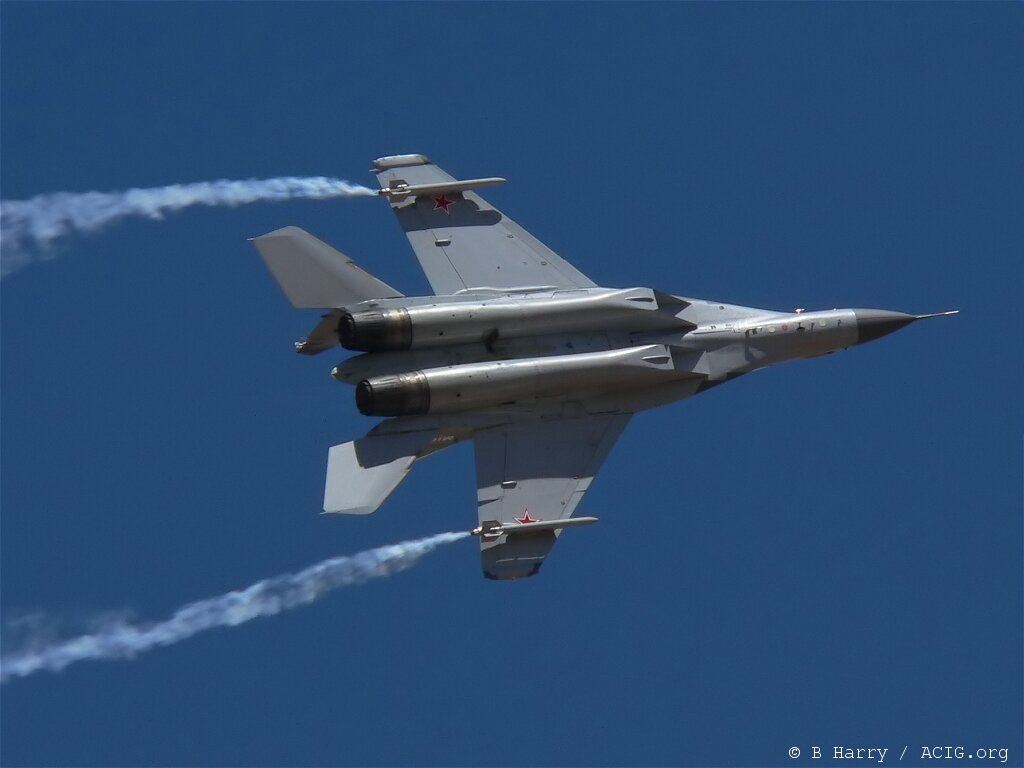
The MiG-29M2 prepares for a Cobra and tail-slide, which the Su-30 didn't perform! This is highly ironic as Sukhoi's famous Viktor Pugachev who most often performs the Cobra, is claimed to have stolen the same maneuver from Mikoyan's Chief Test Pilot Valery Menirski, for airshow use. It was MiG's turn, this year. |
| FILE : 200 KB | |
|
The MiG-29M2's display routine had clearly improved since it's appearance, two years ago. By taking advantage of the Su-30MKI's slightly conservative display routine due to the latter being an operational combat aircraft, some may consider the MiG-29M2 to have been the most impressive aircraft at the show. |
| FILE : 230 KB | |

|
Zvezda Kh-31A, Vympel R-77, KAB-500Kr, the R-73E and a neat lineup of 30 mm rounds, are some of the armament that always accompany MiG's exhibit. Unlike 2003, no other aircraft on the static display lineup this year, had an associated armament display. |
| FILE : 242 KB | |

|
KB-715 itself may not have been seen before but is flown by the very same pilot, Fl.Lt. Ramji Yadav, who flew another example, KB-3109, to Chennai for ICAS, two years ago. Ramji is the youngest pilot of No.28 'The First Supersonics' squadron. Both the close-in maneuverability and BVR capabilities of the MiG-29, have a deadly reputation with all aircraft which have flown against them in DACT. |
| FILE : 219 KB | |

|
The IAF's MiG-29 fleet is progressively receiving the Tarang RWR, although the SPO-15 display panel seems to be retained. A recent mid-life update saw some improvements although a more comprehensive upgrade is being formulated and should take place soon. This example is currently fitted with the SPO-15. Endurance is 1-1.5 hrs with no centerline tank, 2.5 hrs with the centerline tank. This examples has no plumbed hard points for underwing drop tanks but the later deliveries, namely the MiG-29s of No.223 squadron, do. |
| FILE : 218 KB | |

|
The 250 kg NIIP Bars-29 'Barsik' is a development of the original Bars-30MKI, intended for the MiG-29. With a relatively low power output of 1 kW, the radar can detect a 5 sq.m RCS target at 100-120 km, lock on to the same at 85 km. The radar can track-while-scan 15 targets and engage 4 of them simultaneously. As with the original, this set combines electronic scanning with a mechanical drive. |
| FILE : 232 KB | |

|
The 120 kg NIIP Osa-2 is intended for the small nose of the MiG-29UBT. A 5 sq.m RCS target is detected at 85 km and locked onto at 65 km, with the transmitter power output being a mere 700 W. The radar can track-while-scan 8 targets and engage 4 of them simultaneously. The antenna is a purely phased array, with no additional mechanical drive, the whole set consuming 3.6 kW of power at 400 Hz. The very similar Osa-1 is intended for the MiG-21. Both radars may have variable waveforms and sidelobe levels. |
| FILE : 216 KB | |
|
|
|
|
|
|