|
ACIG Exclusives
Chapter 6 : Enter the Rhinos |
 |
|
|
|
| No.30 "Rhinos" were the second and most recent squadron to receive the Su-30MKI, making a quantum leap, the largest possible, from the obsolete MiG-21FLs which they previously operated. All the Su-30MKIs that took part, were from this squadron, although one may have expected the display of HAL-built Su-30MKIs (SB-101, SB-102 etc) instead. The Rhinos also brought a large number of personnel. Aero India could never be anywhere close to a success without the Flanker's participation and that is why every Aero India included one in some form or the other, be it the Su-33 in 1998, a factory Su-30MKI in 2001 or IAF Su-30MKIs in 2001 and 2005. | |

|
The Su-30 is always the most anticipated, most easily identified and most talked about aircraft type, both before and after the show. This is probably true for any airshow in the world that hosts the Flanker, not just this one. This is one silhouette that a layman can't accuse of being an "F-16". |
| FILE : 237 KB | |

|
SB-036 was on static display throughout the show. The loadout includes six R-77, four R-73E training rounds, twelve FAB-250 free-fall dumb bombs and no R-27s for the first time. AsHMs and PGMs normally carried include the KAB-500Kr/L, KAB-1500Kr/L, Kh-25, Kh-31and the Kh-59 but they are'nt likely to be shown any time soon. Even the Litening LDP which has been explicitly mentioned, is still under wraps as far as a public display is concerned. |
| FILE : 217 KB | |

|
A look under the fuselage reveals two dummy R-77s interfaced to the centerline hardpoints through their APU-170E pylons. Twelve 270 kg FAB-250s can also be seen. The bomb's fuze consists of an electro pyro initiator system and the weapon is primarily intended for use against moving trains, aircraft sites and depots. Although the aircraft of No.20 squadron carry the Litening LDP, integration of the same with the aircraft of No.30 squadron has not yet been completed. |
| FILE : 221 KB | |

|
Two other Su-30MKIs (SB-035 and SB-040) took part in the air display, flying in turns. Both these examples look almost as flogged as the Sea Harriers, despite being the newest of MKI deliveries. The black anti-glare panel and a different shade of gray for the nose instead of a lighter gray, are also new. The quality and thickness of paint leaves something to be desired but the selected shade of gray does blend in well with terrain over India, especially over water bodies. |
| FILE : 176 KB | |
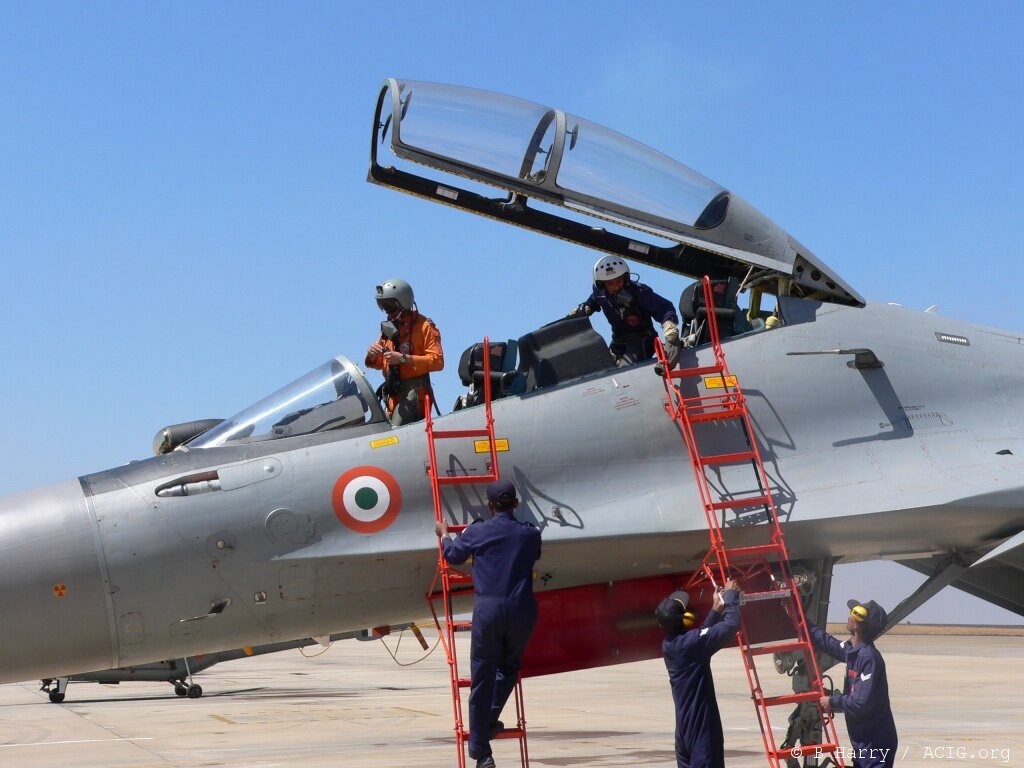
|
Wing Cdr. Sandeep Singh, the CO of No.30, prepares to board his aircraft for flight. Sqn Ldr. T Gopinath occupies the rear seat. No.20 squadron was known to have a maritime role but the orange uniform that the CO uses confirms that No.30 also have the same role. Both squadrons are based at Loheagon AFB, near the city of Pune in the state of Maharashtra. |
| FILE : 217 KB | |

|
SB-035 (C/N 10MK2209) prepares to taxi out. No.30 squadron has a surprising number of younger pilots despite the Su-30MKI being on the highest end of the IAF spectrum. |
| FILE : 164 KB | |

|
SB-035 taxies out. Indigenous equipment aboard include the Radar and Mission Computers, Display processors, RAM-1701 radar altimeter, INCOM 1210A Integrated Radio Communication System, IFF-1410A transponder, Tarang HADF Mk.II RWR. This results in some changes among as well as removal of several external aerials and antennae. |
| FILE : 235 KB | |

|
Even without using TVC, the Su-30MKI has a shorter T/O distance when compared to other aircraft. The handling of this aircraft appears to be flawless, offering the pilot a unprecedented amount of freedom which makes the Su-30MKI look somewhat like a hovering UFO at slow speed. |
| FILE : 188 KB | |

|
Almost immediately after getting his tyres off the ground, the pilot makes a sharp turn towards the left and flies around the base to make an entry from the other side. Aerobatics will be carried out at slow speed but within a very small volume of space that only the Su-30MKI could make use of. |
| FILE : 190 KB | |

|
The CO had already announced his intention to be conservative in his aerobatics, for this was an operational machine that could not afford the stress as put on company-owned examples which the latter intends to eventually sell off. This meant no Cobra maneuver which would put extreme stress on the engine, no use of canards and minimal TVC usage. |
| FILE : 197 KB | |

|
SB-040 taxies out for the air display, it's turn having arrived. The Su-30MKI will go through a continuous upgrade process throughout it's lifetime, covering avionics, the engine as well as structural materials. HAL and ADA have tied up to chart out a programme that will dramatically increase the % of composites in the airframe, compared to the current 6 %. |
| FILE : 211 KB | |

|
The Su-30MKI can take off with maximum internal fuel as well as maximum external payload, meaning a strengthened airframe, landing gear and an MTOW of 38,800 kg. It was previously assumed that the Su-30MKK alone featured the latter but that was purely due to lack of accurate and first hand info. Al-31FP military thrust is also given as 12,700 kgf. |
| FILE : 236 KB | |

|
Fortunately, the agility of the MKI meant minimal effort was good enough to impress. Here, the pilot prepares for the falling-leaf maneuver in which he makes a 360° turn without banking. However, these among other maneuvers weren't done as skillfully as No.20 squadron did, two years ago. Clearly, Wing Cdr. NS Jamwal, CO of No.20, is still the master of the MKI. |
| FILE : 184 KB | |

|
SB-040 lands on completion of it's display routine. With IFR, the aircraft has an endurance of 10 hrs and a range of 8400 km. Those type of sorties flown on a regular basis, have no doubt contributed to the current look of the aircraft. |
| FILE : 221 KB | |

|
Both the airbrake and brake chutes are deployed to slow the aircraft down. Wing Cdr. Sandeep Singh flew both SB-035 and SB-040. The result of being conservative was the MiG-29M2 stealing the MKI's thunder by performing a cobra and tail-slide! |
| FILE : 237 KB | |
|
|
|