|
| Search |
|
|
|
|
ACIG Database
Kazakhstan
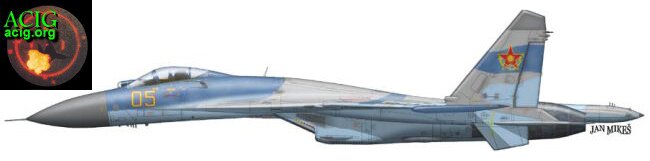 |
| Kazakhistan Air force Su-27 as seen at the 604. Air Base, Taldygorgan, in March 2006. (All artworks by Jan Mikes, unless otherwise stated) |
Russia
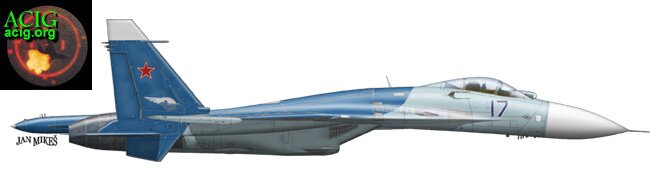 |
| Prototype T-10-17, ‚blue 17‘ joined the testing program in 1982, but the machine was lost in 1983. |
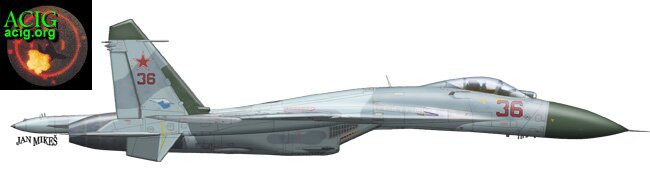 |
| Su-27S from first production batches, ‚red 36‘, Kilp Yavr AFB, Soviet VVS, 1987. First observation of Su-27 by the West took place on January 7, 1987 when two Norvegian F-16s intercepted two Flankers. In April 1987, Norwegian P-3 took the first photography of Su-27. But for the better quality pictures, west had to wait till the September 13, 1987. At that day another Flanker (‘red 36’) came to intercept Norwegian P-3. Flanker passed to less than two meters of Orion at 10. 39. Fifteen minutes later, Flanker approached again and the propellers of Orion struck vertical stabilizer tip of Known-27. Both airplanes returned safelz to thein bases. In the 1990s, the ‘red 38’ was reserialed to ‘red 38’ and it now carries Orion kill marking on the left side of the fuselage. |
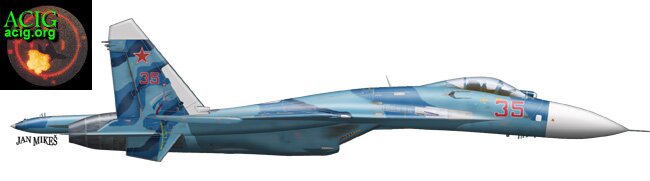 |
| Early production Su-27S ‚red 35‘, Su-27 from 177IAP, Lodeynoye Pole AFB, 2005. |
 |
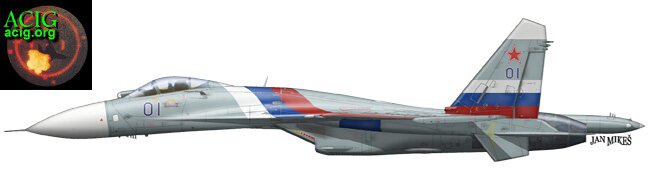
| Su-27S "Blue 01" from the 689th GvIAP Russian Navy, Nivenskoye AFB (Kaliningrad region), 2003. |
 |
| Su-27S "Blue 01" in uniform blue sheme with Russian tricolour, as seen at Chkalov AB (near Lipetsk), in 2005. |
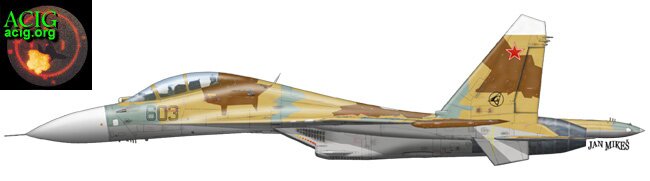 |
| Su-30MK demonstrator ‚603‘ was first shown on IDEX' 93 in Dubai then on FIDAE' 94 in Chile. To reach the Chile, the ‚603‘ crossed non stop the Atlantic without any external fuel tanks ior refuelling. |
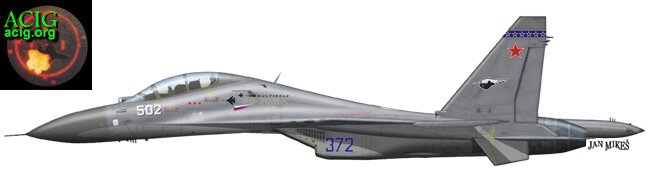 |
| Su-30MKK white ‘502’ - The second pre-production MKK coded ‚502‘was shown presented in Le Bourget in 2001. The machina-with exception of russian marking carries standard Chinese Flanker scheme. |
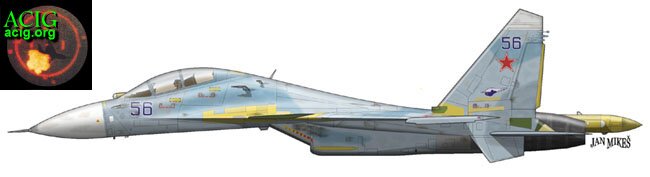 |
| Prototype bort number "56":The First prototype (Sukhou designation Ò-10PMK-2) - the airplane was modified from the Su-27PU. It made its first flight on July 1, 1997, during first phase of testing, it retained the original camouflage and the bort number "56". |
 |
| Su-30MKI Prototype bort number "01": The First prototype was leter repainted in new scheme and received new bort no. "01". The machine was lost on June 12, 1999 at Paris, while being shown on LeBourget Air Show. |
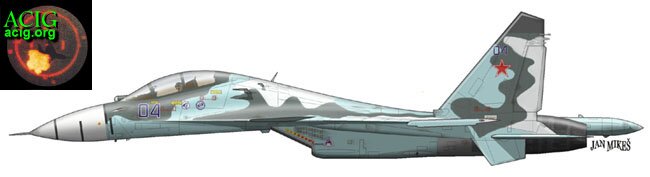 |
| Prototype bort number "04"(1): This prototype was painted in a three-tone, eye catching camouflage. (This camo scheme was also used on Su-30KN prototype, bort no "302"). Originally, this prototype was shown with white radome. |
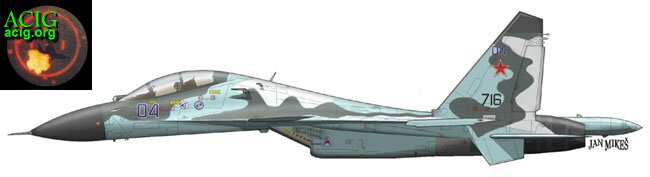 |
| Prototype bort number "04"(2): Later, the radome was apparently replaced and number "716" appeared on the fin. |
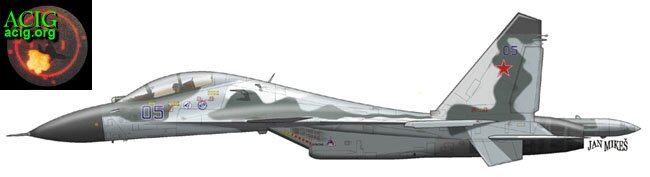 |
| Prototype bort number "05": This prototype carries variation of the same camo scheme as "04" prototype. Was shown in India at Aeroindia 2001, Bangalore. |
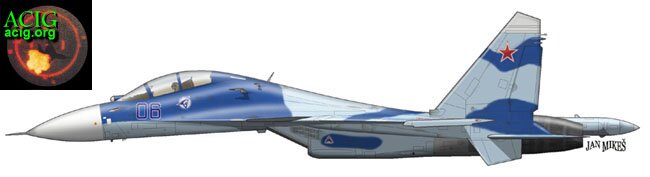 |
| Prototype bort number "06": The second prototype (Sukhoi designation Ò-10PMK-6). Also rebuilt from the Su-21PU. First flown on March 23, 1998. |
Syria (only for display purposes)
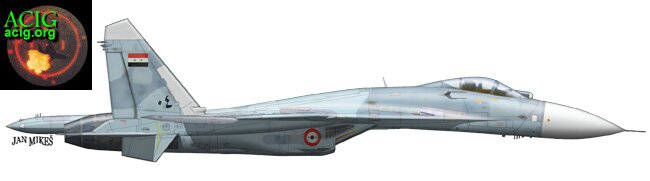 |
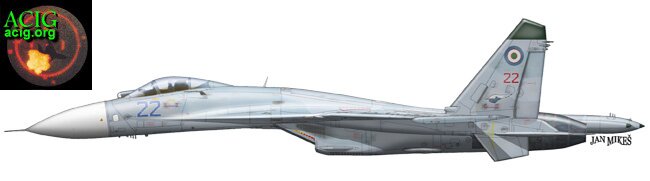
| "04" was one of two Su-27s that caused much uproar back in 2001, when it was sent to Syria for display purposes. Seen by several eyewitneses as wearing Syrian Air Force markings while in Syria, the appearance of this aircraft caused reports that Syria has indeed acquired a batch of Flankers. However, despite at least four such "excursions" to Syrian airfields, the Russians were not successful in selling the Su-27 to that country. There are thus no Flankers in Syria, and this was a "one off" aircraft, marked this way solely for display purposes. |
Ukraine
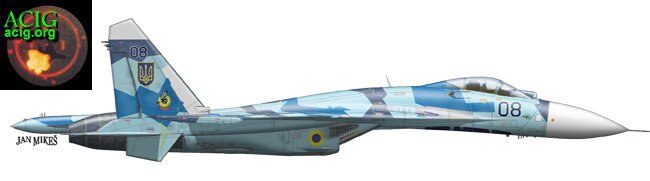 |
| An early production Su-27S "Blue 08" of the Ukraine Air Force, as shown on June 10, SIAD2004, Bratislava, Slovakia,2004. The striking splinter scheme was adopted as standard for Ukrainian Flankers in mid 1990s. Ukraine currently operates 60-70 Flankers. |
 |
| "Red 41" of the 9 IAP Ukrainian Air Force, based in Shitomir/Osernje. This aircraft was seen wearing transitional national markings, used for a short period before current fin flash and roundel were adapted for service. (Tom Cooper) |
Uzbekistan
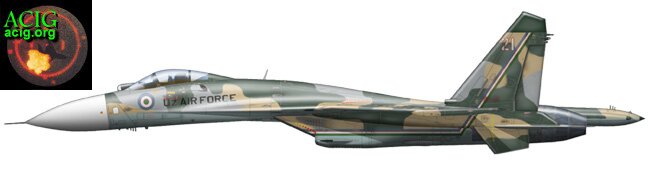 |
| This artwork is showing an Uzbekh Air Force Su-27S, as seen at Chikchik AB, several years ago. Photographic evidence of Uzbekh Flankers in desert camouflage patterns is very rare, and usually of dubious quality: there should be several versions of this pattern, and this reconstruction is based on oral description provided via Linden Hill Imports. |
 |
| Most of Uzbekh Su-27s should still wear the standard camouflage pattern as previously the aircraft of the Soviet and Russian air forces. This example was also seen at Chichik AB, in 2005. The only difference to earlier times is that the Uzbekh national markings were applied over Soviet "Red Stars". Photographic evidence also shows that some Su-27s have their Red Stars only removed, but no UzAF markings applied. |
Venezuela
 |
| Venezuela is the most recent user of fighters from the Flanker-family. The first two Su-30MK2s for the Venezuelan Air Force were delivered as recently as December 2006. |
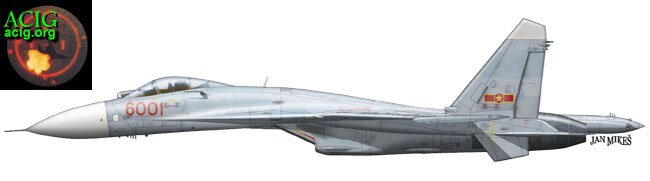
Vietnam
© Copyright 2002-3 by ACIG.org
Top of Page
|
|
|
|
Striking Flankers, Part 2
|
|
Striking Flankers, Part 1
|
|
Exotic Fulcrums
|
|
French ECM-pods
|
|
Lockheed F-94 Starfire
|
|
The Soviet Navy ‘Forger’: Yak-36M, Yak-38, Yak-38U and Yak-38M
|
|
Mil-Helicopters in World-Wide Service, Part 3
|
|
Mil-Helicopters in World-Wide Service, Part 2
|
|
Mil-Helicopters in World-Wide Service, Part 1
|
|
Bomarc
|
|
Falcon and Genie: Two Little-Known US Air-to-Air Missiles
|
|
Bear Hunters, Part 5: ASW Style
|
|
F-14 Tomcat with USN, Part 4
|
|
F-14 Tomcat with USN, Part 3
|
|
F-14 Tomcat with USN, Part 2
|
|
F-14 Tomcat with USN, Part 1
|
|
Sukhoi Su-30 MKI
|
|
Portfolio: RQ-1 Predators in USAF service
|
|
Potfolio: SAM-sites through History, Part 2
|
|
Portfolio: SAM-sites through History, Part 1
|
|
Mirage F.1s in Combat
|
|
New F-16s
|
|
Gone With the Wind
|
|
Portfolio: USN "Aggressors"
|
|
Phantoms Phorever, Part 9: UK
|
|
Phantoms Phorever, Part 8: Spain & Turkey
|
|
Phantoms Phorever, Part 7: South Korea
|
|
Phantoms Phorever, Part 6: Iran
|
|
Phantoms Phorever, Part 5: Greece
|
|
Phantoms Phorever, Part 4: Japan
|
|
Phantoms Phorever, Part 3: Israel
|
|
Phantoms Phorever, Part 2: Germany
|
|
Phantoms Phorever, Part 1: Australia & Egypt
|
|
Dassault Rafale
|
|
MiG-29M2
|
|
MiG-21, Part 2
|
|
MiG-21, Part 1
|
|
Su-27: Russia's Top Fighter of the Cold War?
|
|
Bear Hunters, Part 4
|
|
Bear Hunters, Part 3: Collision with Flanker
|
|
Bear Hunters, Part 2: Korean Style
|
|
Bear-Hunters, Part 1
|
|
The Big "MiG"-Question
|
|
Kfir C.10
|
|
MiG-29 Fulcrum
|
|