|
| Search |
|
|
|
|
Central and Latin America Database
 |
| DAAFAR Museum panorama. (Photo: all photographs by Authors, unless otherwise stated) |
A reminder of the past
Fidel Castro, the man who has been ruling Cuba with an iron fist since 1959, wanted 2006 to be the year of the “energetic revolution”.
What he could not foresee, though, was that oil prices would increase so much this year, making it difficult for the country to supply enough electricity. Fifteen years after the collapse of the Soviet Union, and while a US embargo is still in force, Cuba now relies on oil from Venezuela and aid from China.
Until the collapse of the Soviet Union in 1991, Cuba was especially proud of its Air Force : military parades included flights over Havana. Numerous pictures and officials documents, date from that period. More recent photographs of Cuban fighter jets are not easy to find; obtaining information about the Cuban air force (DAAFAR) is even less easy – at least for a private observer.
Military air traffic is very poor (or non-existant) over Havana. “Spotting” around military facilities is a still a “risky“ game in Cuba. But anyone interested in planes can still go to the DAAFAR Museum, the “Museo del Aire”, open to the public. The “Museo del Aire” is located 15 kilometres away from the centre of Havana, in the district of La Lisa (Tel : 271-0632 ; calle 212, between Av.29 and Av.31, La Coronela).
The Museum is open from Tuesday to Sunday. Entrance fee is 2 Convertible Pesos (“CUC”, about 2 Euros) for unguided visit, and two more if you want to takes pictures. The exhibition shows 20 different types of aircrafts, missiles and anti-aircraft artillery belonging to the “Fuerza Aerea Revolucionaria”.
For the European traveller, visiting an “air museum” under palm trees is in itself an unforgettable experience. Unfortunately, a trip to Cuba raises many questions and provides few answers. The day we visited the guide was away. Nevertheless we were able to make very interesting observations with the help of a man “armed“ with a screwdriver : the “mechanic of the museum” as we called him later.
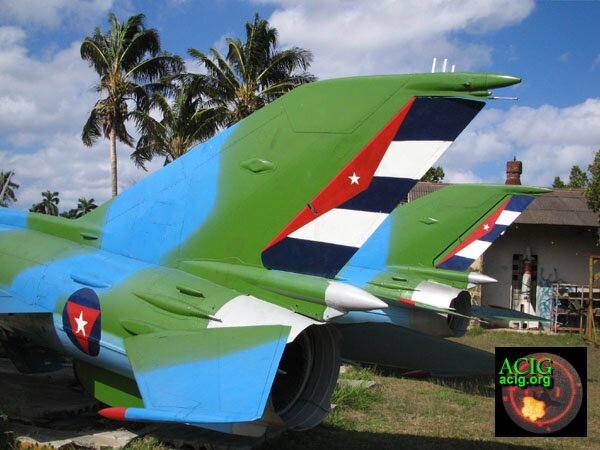 |
| Hand painted Cuban flags on MiG-21s. |
MiGs in Technicolor
What struck us most when visiting the DAAFAR museum was the colours of the aircrafts : deep blue and soft green for the Mi-24, for example, very unusual on this helicopter, but rather effective in this part of the world where this big Russian gunship often operates over the jungle and the Caribbean sea. The "mechanic of the museum" claimed that all the colours were authentic and the camo schemes original. To us it was clear that some airplanes had been repainted at least once [1].
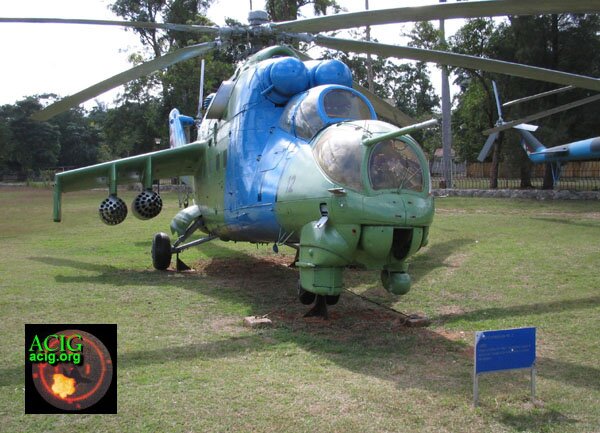 |
| DAAFAR Mi-24. |
 |
| Mi-8 in Museum.... |
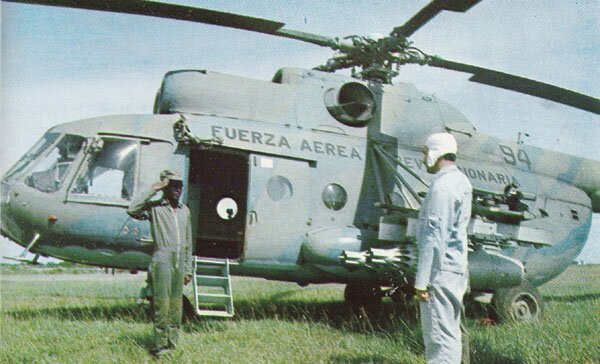 |
| ...and the way DAAFAR Mi-8s used to look while in service, back in the 1980s. (DAAFAR) |
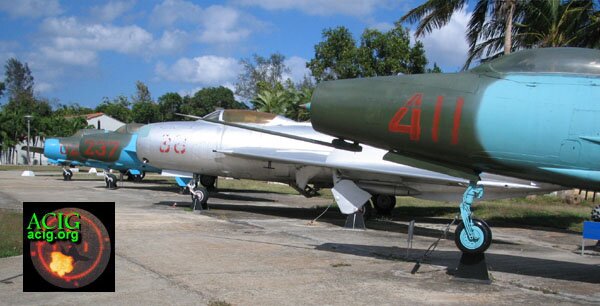
Tropical climate make constant maintenance a necessity, even when planes don’t fly. Some fighters like the MiG-21F-13 are damaged by corrosion. Other planes are generally in good condition...for a museum!
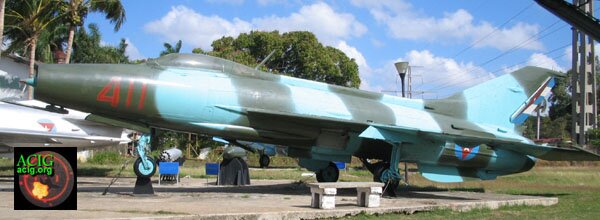 |
| One of MiG-21F-13s is in poor condition, but this example still shows its camouflage pattern to advantage. |
Four versions of the “Fishbed” are set. One MiG-21PFM (‘Black 1006’), one MiG-21UB (‘Black 502’), one MiG-21MF (‘Black 111’), and the MiG-21F-13 (‘Red 411’). All the side-numbers and nationality identifications are hand-painted !
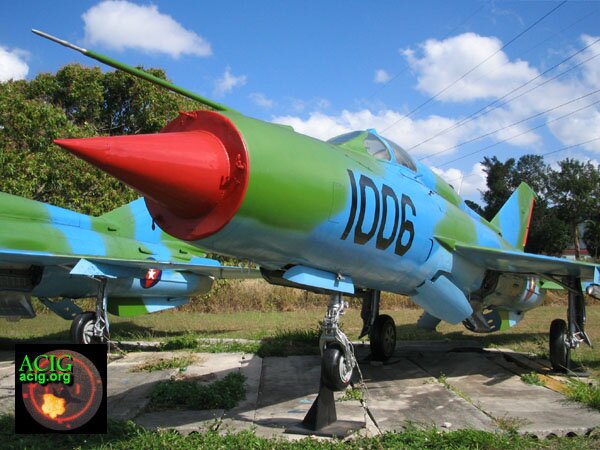 |
| Above and bellow: MiG-21PFM serialled 1006... |
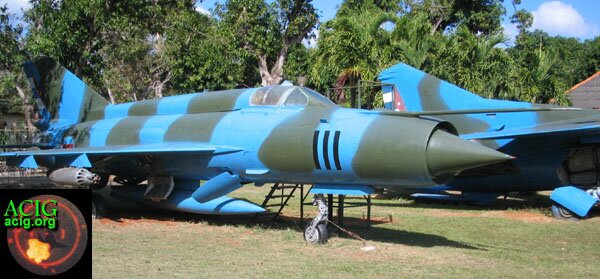 |
| ...and MiG-21MF serialled 111. |
 |
| Fly past over Havana on the 20th Anniversary of the Revolution, in 1979. (DAAFAR) |
 |
| Photo from better times: propaganda picture showing a seemingly "endless" row of DAFAAR MiG-21s. (DAAFAR) |
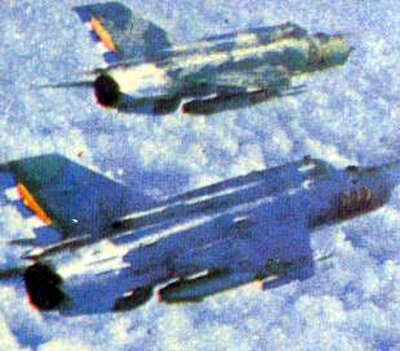 |
| DAAFAR MiG-21s as seen in camo pattern used in the 1980s. (US DoD) |
The DAAFAR museum collection also includes one two-seater MiG-15UTI, a MiG-17 sporting the light blue and dark brown scheme of the 198O’s, while the MiG-19P ‘Red 88’ is set in full aluminium “colour”.
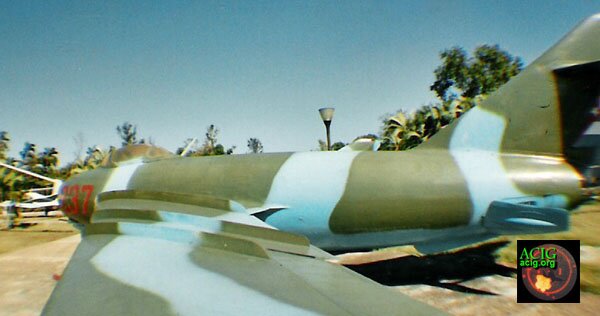 |
| DAAFAR MiG-17 on display in Museum. |
All these planes were put out of service years ago, and the MiG-19 had the shortest career of all combat aircrafts in Cuba: five years only, from 1961 to 1966. According to the "mechanic of the museum" (a former FAR technician?), the “Farmer” was not very appreciated by its pilots! The aircraft also suffered from muggy weather: many engine failures were due to the defective air cooling system of the Toumansky RD-9B.
Along with the MiG-19, the DAAFAR was the first Latin American Air Force flying a supersonic fighter jet and had a high rate of accidents. The ‘Red 88’ of the museum was damaged probably during a “hard landing”, and its titanium-built tail was locally repaired. In fact to compensate for the lack of parachute drag, Cuban MiG-19P often used their arresting hook.
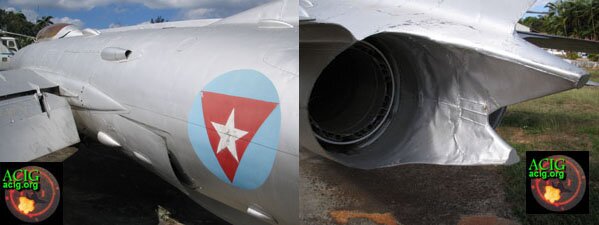 |
| Details of the locally repaired tail of the MiG-19P. The type remained in DAFAAR service for only five years. |
Remembering the Cold War.
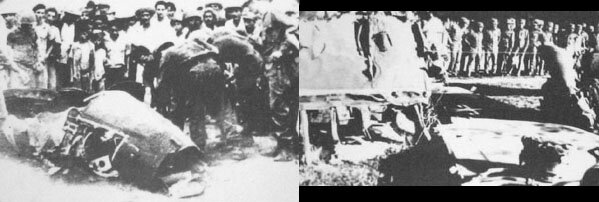
The peak in the career of the operational Cubans MiGs was undoubtedly the Bay of Pigs crisis, in October 1962. While the whole planet held its breath, the DAAFAR was in the front row. Skirmishes between the Cuban Air force, and the US Air Force and Navy were frequent – and sometimes deadly. During these historic weeks , the DAAFAR claimed victories against two Lockheed F-104A Starfighters and one McDonnell RF-101C Voodoo [2]. It also reported a “dog-fight” against a USN Vought RF-8E Crusader, but the main victory, and the most spectacular one, was the destruction of a U-2 spy plane by a Cuban missile on October 27, 1962. This episode was widely exploited by Cuban propaganda. Several parts of the "claimed destroyed" Lockheed U-2 were shown to journalists.
Nowadays, the engine of this U-2 is reported to be displayed at the “Museum of the Revolution” in central Havana , and the left part of the airplane’s wing at the DAAFAR museum . In fact, the real origin of the wreck is still unknown. There is no identifiable serial number on the wing, and nobody knows what happened to the other parts of this “spy plane”.
According to our “guide” the U-2 was shot down by two SA-2 missiles, launched by the DAAFAR and the American pilot, Capt. Rudolf Anderson Jr., was killed.
The DAAFAR museum also keeps a single SA-2 missile and a ramp of four SA-3 missiles.
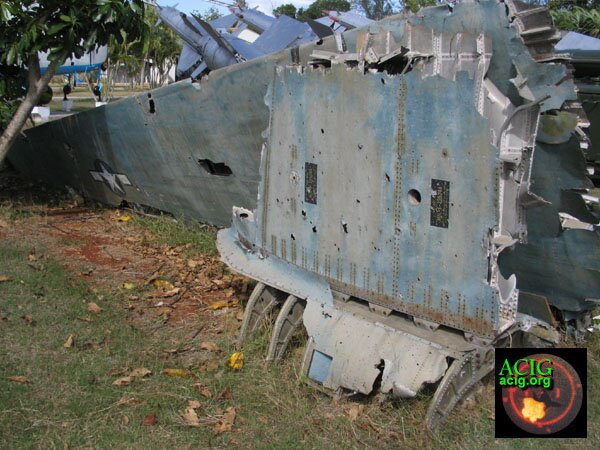 |
| Wing and tail of the downed U-2 as preserved in DAAFAR Museum. |
 |
| Engine of the U-2 shot down back in 1962. |
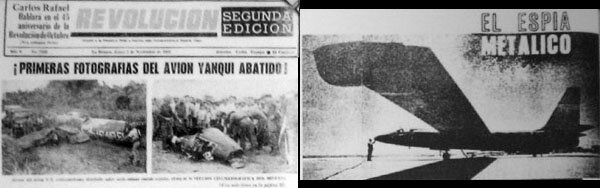 |
| Scans of contemporary press reports about the downing of Anderson's U-2. (DAAFAR Museum) |
Floggers in Angola
During the Cold War, the Cuban Air Force played a major role in numerous operations worldwide, particulary in Africa.
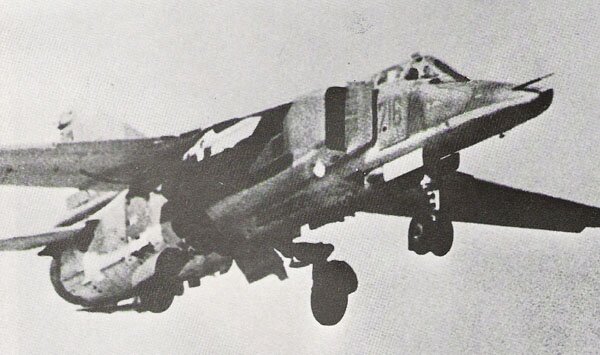
The DAAFAR is known to have deployed advisers, pilots and weapons to Ethiopia, Guinea, and Angola. During the Cuban involvement in the later country, Cuban-flown MiG-21MFs and MiG-23MLs were confronted by South African Air Force (SAAF) Dassault Mirages. On 27 September 1987, the SAAF Mirage F1CZ n°206 was damaged by a R-6OMK missile fired by a “Flogger” during an operation over southern Angola [3].
When Cuban forces withdrew from Angola in 1989, the surviving MiG-23MLs were shipped back to Cuba, and several MiG-23s of the museum are said to be veterans from the war in Angola.
Different versions of MiG-23s are on display: a MiG-23UB ‘Black 706’, fighter-bomber MiG-23BN ‘Red 711’ (with a Red Star painted on the air intake), and three MiG-23ML interceptors. One of these fighters, ‘Black 822’, is decorated with an unusual five coloujrs “frog” camouflage pattern, with a classic Cuban national flag on the rudder. The two others MiGs were totally washed out when we visited the museum.
 |
| Above and bellow: DAAFAR once used to have a considerable number of various MiG-23-versions in service, including MiG-23UBs and MiG-23BNs... (US DoD) |
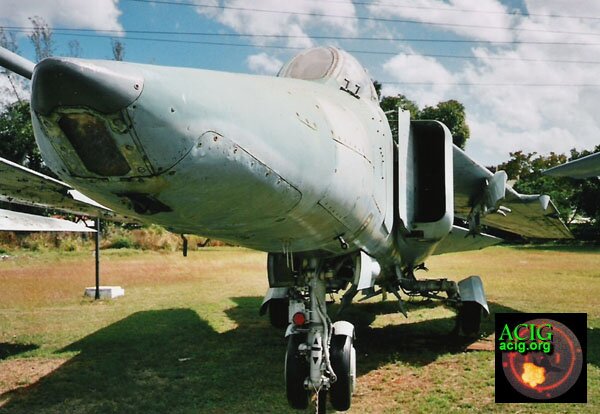 |
| ...one of BNs is today on display in Museum as well. |
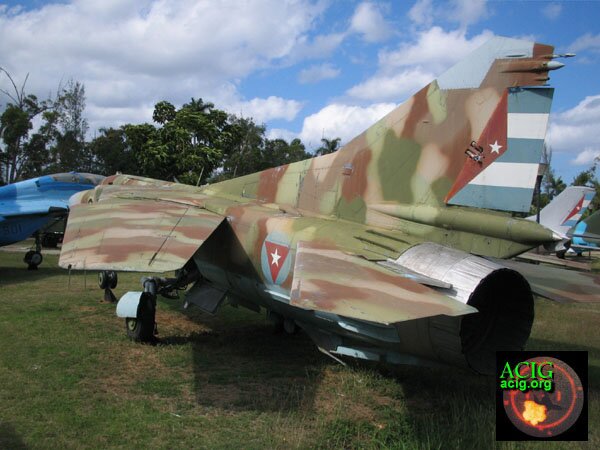 |
| DAAFAR MiG-23MF: a former "Angola-Warrior"? |
”Recent” MiGs
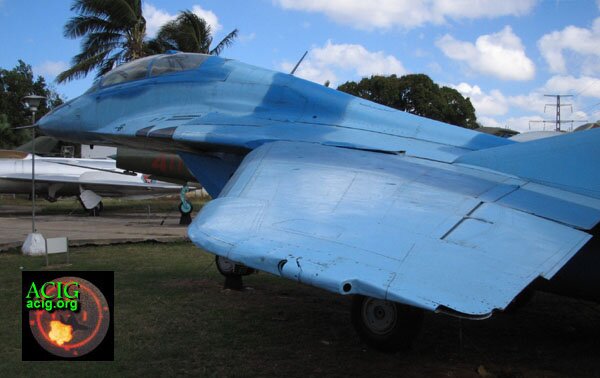
There are not the only “rusty” aircraft in the museum: we were surprised to discover a “modern” MiG-29 as well: Cuba is thus the only country except the USA and Russia to have done anything of this kind!
The aircraft is the two-seater version of the “Fulcrum”, but both K-36DM ejection seats have been removed. In fact all the parts of the plane which could be used as spare parts have been dismantled. The Head Up Display and the video-infrared tracker IRST are also gone. All the ECM systems have been removed too. The aircraft doesn’t carry any weapons or external fuel tanks.
The FAR was one of the first air forces to operate the MiG-29. Initially Cuba had planned to get as many as 40 Fulcrums. Only four MiG-29s seem to be operational today, and the Fulcrum remains the mainstay of the DAAFAR. The MiG-29UB of the Museum is marked ‘Red 901’. On February 24th 1996, a Cuban MiG-29, escorted by a MiG-23 used as radio relay, was involved in an armed incident with two US-registered Cessna 337 light aircraft, owned by an anti-Castro organisation. Both Cessnas were shot down, reportedly inside the Cuban air space. Both crews and their passengers were killed.
The United Nations concluded that the MiG deliberately opened fire on the civil aircrafts without trying to warn them by radio, thus violating international rules. The UN report revealed that the Cuban fighter shot two missiles against the Cessna N2456S and N5485S [4].
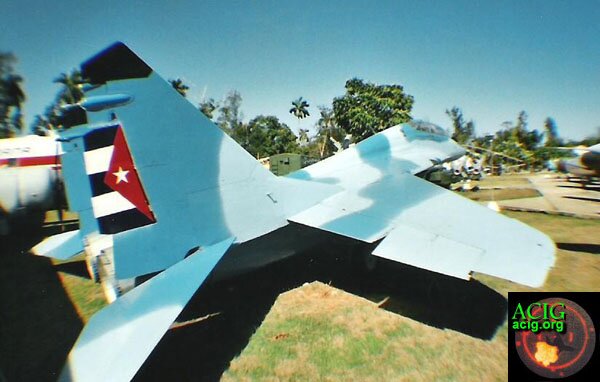 |
| Above and bellow: one of only two MiG-29UBs delivered to Cuba ended its career early - in DAAFAR Museum. Cuba was thus only the third country world-wide to have MiG-29s in a Museum. |
Sources & Bibliography
This article is based on details acquired through own research, acquired during a visit in Cuba, as well as several sources of general reference (see bellow).
Notes
[1] Air Fan magazine n°314, January 2005
[2] ACIG Forum
[3] Dick Lord’s book “VLAMGAT”; some Cuban sources indicate this engagement occurred over “Northern Namibia”
[4] United Nation press service
© Copyright 2002-3 by ACIG.org
Top of Page
|
|
|
Latest Central and Latin America Database
|
|
Caribbean MiGs
|
|
Mexican Naval Mil Mi-17s
|
|
Aztec Rotors - Helicopters of Mexican Air Force
|
|
Fuerza Aerea Colombiana
|
|
Forca Aerea Brasileira
|
|
Drug-Busting Operations Air-to-Air Victories
|
|
Central & South American Air-to-Air Victories
|
|
Cuban Air-to-Air Victories
|
|
Peru vs. Ecuador; Alto-Cenepa War, 1995
|
|
Venezuelan Coup Attempt, 1992
|
|
Panama, 1989; Operation "Just Cause"
|
|
Grenada, 1983: Operation "Urgent Fury"
|
|
El Salvador, 1980-1992
|
|
Nicaragua, 1980-1988
|
|
El Salvador vs Honduras, 1969: The 100-Hour War
|
|
Cuban Crisis, 1962: ORBATs and OPLANs
|
|
Clandestine US Operations: Cuba, 1961, Bay of Pigs
|
|
Argentina, 1955-1965
|
|
Guatemala since 1954
|
|
Costa Rican Civil Wars: 1948 & 1955
|
|
Dominican Republic since 1945
|
|